
How Whiteson Detergent Pressure-Tested Its Core Ad Claim Across 5 Consumer Segments — at 90% Real-World Accuracy
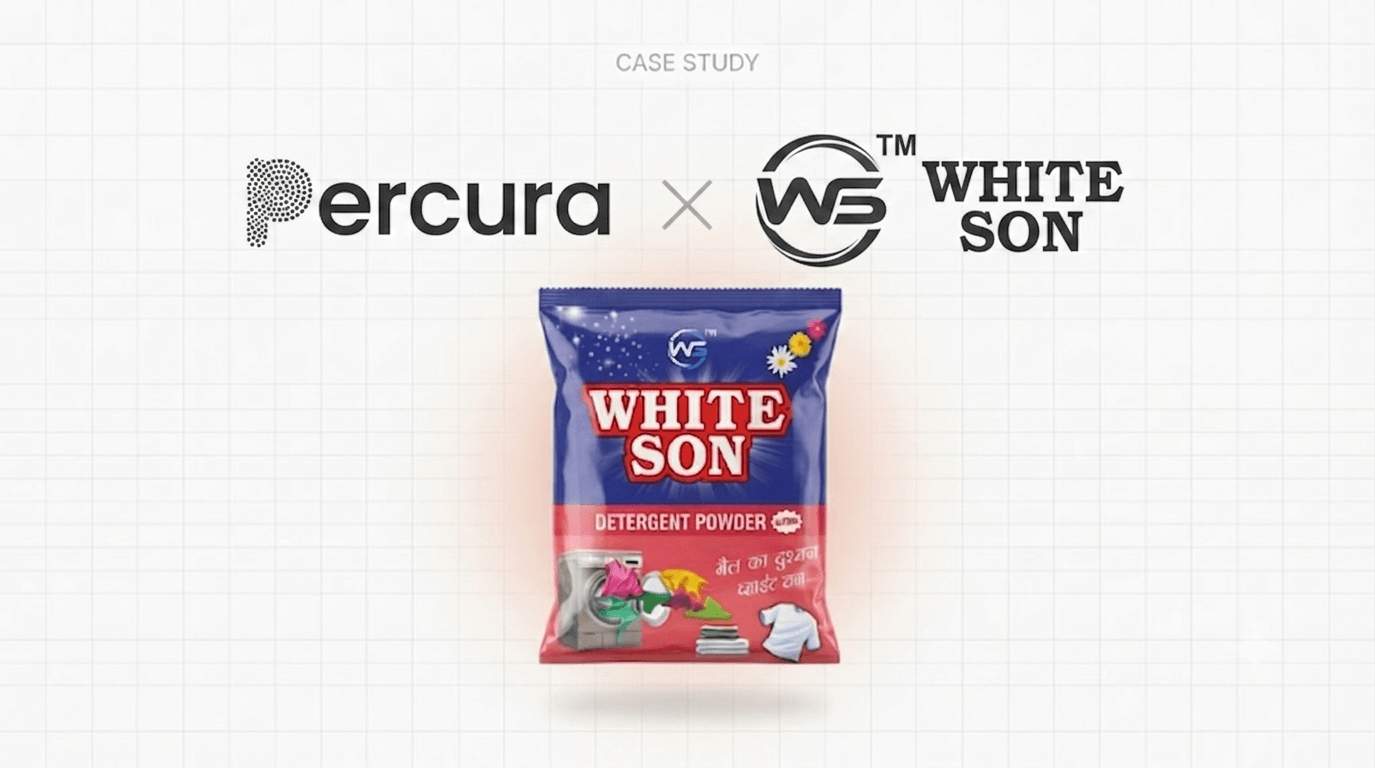
Whiteson Detergent partnered with Percura to stress-test the central claim behind Whiteson Washing Powder — that it removes tough stains and keeps fabric soft — along with its eco-friendly positioning, before scaling either in advertising. Whiteson had already fielded a real, human survey to answer this. Percura built a synthetic panel to answer the same questions, blind, and matched Whiteson's real results with 90% accuracy — at a fraction of the cost and none of the wait.
The Goal
Whiteson Detergent — a Faridabad-based washing powder manufacturer competing against Ghadi, Nirma, and Wheel in India's crowded, price-sensitive detergent market.
Whiteson's pitch rests on two claims: that Whiteson Washing Powder fights tough stains without damaging fabric, and that it's eco-friendly. Before pushing this positioning harder in packaging and ad spend, the brand needed to know whether real consumers — across income levels, geographies, and washing habits — actually believed either claim. And it needed proof that an AI-simulated consumer panel could answer that question as reliably as a real fielded survey, before trusting it for future research.
The Challenge
Whiteson had already fielded a real, human survey to test this — and it was neither cheap nor fast:
- !Recruiting and fielding across 5 distinct consumer segments — urban working professionals, rural homemakers, middle-class family managers, budget-conscious students, and elderly traditional housewives — spanning Mumbai and Bangalore to rural villages in UP, Bihar, Rajasthan, and Odisha.
- !High financial barriers: The India survey cost Whiteson ₹15,000–20,000 for just 30 respondents; fielding the same 30-respondent study in the US would have cost ₹50,000–60,000.
- !Weeks of complex operations to coordinate with and survey segments that do not show up on standard online panels, such as rural homemakers and elderly traditional consumers.
- !The need to replace physical research with a synthetic panel without losing the qualitative nuance — the distinct reasoning behind consumer purchase preferences and local constraints.
Our Solution
Mirrored Whiteson's Real Buyer Segments With Synthetic Personas
Whiteson had already fielded its real survey with 30 human respondents across 5 segments — Urban Working Professionals, Rural Homemakers, Middle-Class Family Managers, Young Budget-Conscious Students, and Elderly Traditional Housewives — spanning Mumbai to rural UP, Bihar, Rajasthan, and Odisha. Percura built a matching synthetic panel across the same 5 segments, without access to Whiteson's real answers.
Ran the Identical Claims Stress-Test, Blind
The synthetic panel answered the exact same questions Whiteson's real respondents had: how believable is the 'removes stains and protects fabric' claim, how much does hand-wash vs. machine-wash versatility matter, how much do they trust the eco-friendly label, and what price tier they'd assume the product sits in.
Ran the Same Forced-Choice Test Against the Competition
The synthetic personas were also made to pick between Whiteson, Ghadi, Nirma, and Wheel — and explain why — so Percura's output could be checked question-for-question against what Whiteson's real respondents had actually said and chosen.
Results & Impact
Accuracy
~90% match between Percura's synthetic responses and Whiteson's real human survey data, across all 5 segments.
Cost
~97% lower than the real fielded survey in India (~99% lower than the equivalent US cost).
Reach
Hard-to-field segments — rural homemakers in Odisha/MP and elderly housewives in Varanasi/Amritsar — simulated instantly, with zero recruiting logistics.
With Percura, Whiteson was able to:
- Confirmed that the core 'stain removal + fabric care' messaging requires adjustment before launching national ad campaigns.
- Identified precisely which consumer segments buy into eco-friendly labels and which demographics completely tune them out.
- Mapped competitive positioning against Ghadi, Nirma, and Wheel segment-by-segment instead of averaging data into standard top-line reports.
- Validated synthetic audience simulation as a viable, highly reliable research tool for future product testing.
"Percura helped Whiteson pressure-test — and in places, challenge — its own product claims before a single rupee went into media, at a level of accuracy that would normally take weeks of real-world fieldwork to confirm."
What We Learned
Below are key strategic insights validated by both the real survey respondents and replicated independently by Percura's synthetic personas:
The eco-friendly claim isn't landing anywhere.
Across Whiteson's real respondents, every segment scored eco-trust below neutral (1.8–2.7 out of 5). Even middle-class family managers — the segment most receptive to Whiteson's other messaging — weren't convinced by an eco-friendly label with no certification behind it. One real respondent, a homemaker, put it plainly: these are 'just words on a packet.' This isn't a copywriting fix. It needs an actual certification mark or third-party proof before it moves anyone — and Percura's synthetic panel flagged this exact pattern independently, without seeing these real answers first.
The headline claim reads as ad copy, not a promise.
'Removes tough stains and keeps fabric soft' scored low across every single real-world segment (2.17–2.67/5). The recurring reaction in respondents' own words: it 'sounds like typical ad copy' and 'usually one comes at the cost of the other.' Consumers have heard this exact combined claim from every detergent brand before. Saying it louder won't fix that — a visible before/after demo or a trial-size sachet might. Again, Percura's blind synthetic panel landed on the same skepticism, at the same intensity, per segment.
Whiteson's loyalty problem is segment-specific, not universal.
In Whiteson's real forced-choice results, the brand picked up genuine consideration from urban professionals and middle-class family managers — the segments where it already has some shelf visibility. But among rural homemakers and elderly traditional housewives, real respondents didn't choose Whiteson a single time out of 12. Both segments defaulted straight to Ghadi, Nirma, or Wheel — brands described as having 'decades of use' and being 'what everyone in the village trusts.' That's not a formulation problem. It's a distribution and trust-building problem, and no ad claim fixes it on its own. Percura's synthetic panel reproduced this exact segment split independently — which is a large part of how the 90% accuracy number was validated.
Simulate your target audience
Get real-world-accurate insights before you spend a rupee testing them for real.